
The Snapdragon 8 Elite marked one of the biggest changes in Qualcomm’s flagship smartphone processor strategy. Introduced in October 2024, it replaced the expected “Snapdragon 8 Gen 4” branding with the new Elite name and introduced Qualcomm’s second-generation custom Oryon CPU architecture to smartphones.

Table of Contents
Rather than simply increasing clock speeds or adding more cores to an existing design, Qualcomm redesigned important parts of its flagship mobile platform around custom CPU technology, a new Adreno GPU architecture, a more capable Hexagon NPU and an updated connectivity platform.
The result is a processor designed for much more than traditional smartphone performance. Snapdragon 8 Elite was built for demanding gaming, on-device generative AI, advanced photography, high-resolution video, fast connectivity and sustained multitasking.
Qualcomm claims that the Snapdragon 8 Elite delivers up to a 45% improvement in CPU performance, 44% better CPU power efficiency, 40% higher GPU performance and 40% better GPU power efficiency compared with its predecessor. Qualcomm also says the entire system can achieve up to 27% overall power savings.
The processor appeared in flagship smartphones from companies including Samsung, OnePlus, Xiaomi, ASUS, Honor, OPPO, Vivo, RedMagic, realme, Motorola and others.
This guide explains what makes Snapdragon 8 Elite different, how its CPU and GPU work, what it means for AI and gaming, how its connectivity works, which smartphones use it and what consumers should know before buying a Snapdragon 8 Elite phone.
What Is Snapdragon 8 Elite?
Snapdragon 8 Elite is a premium smartphone system-on-chip, or SoC, developed by Qualcomm. It was officially unveiled on October 21, 2024, and became Qualcomm’s flagship smartphone platform for the 2025 generation of Android devices.
An SoC combines several important computing components into one platform. Instead of being just a CPU, Snapdragon 8 Elite integrates:
- Qualcomm Oryon CPU
- Qualcomm Adreno GPU
- Qualcomm Hexagon NPU
- Qualcomm Spectra ISP
- Snapdragon X80 5G Modem-RF System
- FastConnect 7900 connectivity
- Memory controllers
- Security technologies
- Display and video processing technologies
- Camera processing capabilities
This integration allows the different components to work together rather than functioning as completely separate chips.
One of the most important changes is the introduction of the second-generation Qualcomm Oryon CPU. Qualcomm had previously introduced Oryon in its PC-focused Snapdragon X processors, but Snapdragon 8 Elite brought the architecture into its smartphone platform.

Snapdragon 8 Elite vs Snapdragon 8 Gen 4
One of the easiest sources of confusion is the name.
Before launch, many industry observers expected Qualcomm’s next flagship smartphone processor to be called Snapdragon 8 Gen 4. Qualcomm instead introduced the Snapdragon 8 Elite name.
Therefore:
Snapdragon 8 Elite = the processor many people expected to be called Snapdragon 8 Gen 4.
It should not be confused with later processors carrying the Snapdragon 8 Elite Gen 5 name.
The newer Snapdragon 8 Elite Gen 5 was announced in September 2025 and uses a third-generation Oryon CPU. It is a successor rather than a different name for the original Snapdragon 8 Elite.
That distinction is particularly important when comparing smartphones released across different years.
Snapdragon 8 Elite Architecture
The Snapdragon 8 Elite is built using a 3nm manufacturing process and combines Qualcomm’s custom Oryon CPU with its Adreno GPU and Hexagon AI processing architecture.
Qualcomm lists the standard Snapdragon 8 Elite with CPU speeds of up to 4.47GHz, although the company notes that 4.32GHz versions are also available depending on the platform implementation.
The architecture is designed around high-performance custom CPU cores rather than following the traditional configuration found in many earlier Snapdragon flagship processors.
This gives manufacturers considerable processing power for applications that depend heavily on CPU performance.
Qualcomm Oryon CPU
The CPU is arguably the most significant part of Snapdragon 8 Elite.
Qualcomm’s Oryon architecture was originally developed as a custom CPU design intended to compete with the performance of Apple’s silicon and other high-performance computing architectures.
With Snapdragon 8 Elite, Qualcomm brought that custom design into smartphones.
The CPU can reach up to 4.47GHz on Qualcomm’s reference platform. Certain smartphone implementations use a lower maximum frequency, such as the 4.32GHz configuration found in the OnePlus 13.
Qualcomm claims:
- Up to 45% higher CPU performance
- Up to 44% greater CPU power efficiency
- A very large shared cache
- Up to 4.47GHz CPU frequency
These improvements matter in everyday applications because the CPU handles many tasks that users perform constantly.
Launching applications, processing web pages, handling background tasks, manipulating large files, running complex calculations and coordinating AI workloads can all benefit from higher CPU performance.
Why the Oryon CPU Matters
Smartphone performance is not determined by clock speed alone.
A processor with a high clock frequency still needs an efficient architecture, adequate cache, fast memory and a strong thermal system.
The Oryon CPU attempts to improve all of these areas simultaneously.
This is particularly useful for high-end smartphones because modern applications increasingly combine CPU, GPU and AI workloads.
For example, a photo-editing application may use the CPU for application logic, the GPU for image effects and the NPU for AI-powered object recognition.
The Snapdragon 8 Elite is designed to coordinate these workloads efficiently.
Snapdragon 8 Elite GPU
Graphics performance is another major focus of Snapdragon 8 Elite.
The platform uses Qualcomm’s Adreno GPU with a new architecture designed to improve both performance and efficiency.
Qualcomm claims up to a 40% improvement in GPU performance and up to a 40% improvement in GPU power efficiency compared with the previous generation.
That makes Snapdragon 8 Elite particularly interesting for mobile gamers.
Modern Android games increasingly use high-resolution textures, advanced lighting, physics simulations, realistic environments and sophisticated post-processing effects.
The GPU is responsible for rendering much of this visual information.
Ray Tracing
Snapdragon 8 Elite also supports hardware-accelerated ray tracing technologies.
Ray tracing attempts to simulate how light behaves in a virtual environment.
Instead of simply displaying pre-calculated lighting, supported games can calculate reflections, shadows and lighting interactions dynamically.
When implemented properly, ray tracing can improve:
- Reflections
- Shadows
- Lighting
- Environmental realism
- Material appearance
However, support depends on game developers. Having hardware capable of ray tracing does not automatically mean every Android game will use it.
Unreal Engine 5
Qualcomm also promotes Snapdragon Elite Gaming features designed to work with modern game engines, including Unreal Engine 5.
Technologies such as Nanite can help developers create highly detailed virtual environments.
This is significant because mobile games are increasingly adopting technologies previously associated with PCs and consoles.
Gaming Performance
For gamers, Snapdragon 8 Elite provides several advantages.
The combination of a powerful Oryon CPU, Adreno GPU and advanced memory architecture allows flagship phones to handle demanding games at high frame rates.
The processor is particularly well suited to:
- Competitive shooters
- Open-world games
- Racing games
- Emulation
- High-resolution gaming
- Cloud gaming
- Game streaming
- Extended gaming sessions
However, the processor is only one part of gaming performance.
A Snapdragon 8 Elite phone with poor cooling may not sustain peak performance as effectively as a larger phone with a sophisticated vapor chamber.
This means two Snapdragon 8 Elite smartphones can produce different gaming experiences even though they use the same SoC.
The display, cooling system, battery, software optimization and manufacturer performance modes all matter.
Thermal Management
One of the challenges of high-performance smartphone processors is heat.
A processor can deliver exceptional peak performance, but sustained workloads can cause temperatures to rise.
The phone may then reduce processor frequencies to control heat and power consumption. This process is commonly known as thermal throttling.
Snapdragon 8 Elite’s improved efficiency helps reduce the amount of energy required for a given workload, but the smartphone manufacturer still plays an important role.
Gaming phones often have much larger cooling systems than conventional flagship smartphones.
Some manufacturers use:
- Large vapor chambers
- Graphite layers
- Thermal interface materials
- Multi-layer cooling systems
- Dedicated gaming modes
Consequently, Snapdragon 8 Elite should be considered a platform rather than a guarantee of identical performance across every phone.
AI Performance
Artificial intelligence is one of the biggest reasons modern smartphone processors have become increasingly complex.
Snapdragon 8 Elite includes Qualcomm’s Hexagon NPU as part of its AI Engine.
Qualcomm says the Snapdragon 8 Elite’s Hexagon NPU delivers up to a 45% improvement in AI performance and up to 45% better performance per watt compared with the previous generation.
The NPU is designed specifically for AI and machine-learning workloads.
Instead of sending every AI task to a cloud server, compatible applications can perform many operations directly on the smartphone.
This is called on-device AI.
What Can On-Device AI Do?
Depending on the smartphone manufacturer’s software, on-device AI can be used for:
- Image recognition
- Voice processing
- Generative image editing
- Text summarization
- Translation
- Noise reduction
- Background removal
- Portrait processing
- Photo enhancement
- Video enhancement
- Personalization
- AI assistants
The benefit is that certain tasks can be performed without sending all data to a remote server.
This can potentially improve response times and privacy while reducing dependence on an internet connection.
Multimodal Generative AI
Snapdragon 8 Elite was designed with multimodal AI in mind.
Multimodal AI means an AI system can process different types of information rather than only text.
For example, an AI assistant might process:
- Text
- Images
- Voice
- Video
- Sensor information
Qualcomm specifically highlights multimodal generative AI support as one of the major capabilities of Snapdragon 8 Elite.
The practical experience, however, depends heavily on software.
The processor provides the hardware foundation, while smartphone manufacturers and application developers determine which AI features are actually available.
Camera Processing
Modern smartphone photography depends heavily on computational photography.
The image sensor captures raw information, but the processor must transform that information into a finished photograph.
Snapdragon 8 Elite includes Qualcomm’s Spectra image signal processor, which works alongside the CPU, GPU and AI engine.
Qualcomm highlights real-time semantic segmentation and AI-powered image processing among the platform’s capabilities.
Computational Photography
Computational photography can improve smartphone images through techniques such as:
- Multi-frame processing
- HDR
- Noise reduction
- Scene recognition
- Skin-tone optimization
- Sky detection
- Object recognition
- Low-light processing
Instead of treating an image as a simple collection of pixels, the processor can identify different areas of a scene and apply different processing techniques.
For example, a phone can potentially recognize a person’s face, the sky and a building and process each area differently.
Video Recording
The platform also supports advanced video processing.
The actual camera resolution and recording formats depend on the smartphone manufacturer and sensor configuration.
This is important because a processor may support advanced video capabilities while a particular smartphone does not expose every feature.
Camera hardware, storage speed, thermal management and software all influence the final result.
Connectivity
Snapdragon 8 Elite integrates Qualcomm’s Snapdragon X80 5G Modem-RF System.
Qualcomm lists peak download speeds of up to 10Gbps and peak upload speeds of up to 3.5Gbps for the platform.
Actual speeds will normally be much lower because they depend on:
- Carrier network
- Spectrum availability
- Network congestion
- Signal strength
- Location
- Carrier aggregation
- Smartphone antenna design
The processor also supports advanced 5G technologies, including sub-6GHz and mmWave depending on the device and regional implementation.
Wi-Fi 7
Snapdragon 8 Elite supports Wi-Fi 7 through Qualcomm’s FastConnect 7900 platform.
Qualcomm lists peak Wi-Fi speeds of up to 5.8Gbps.
Wi-Fi 7 can offer improvements in throughput, latency and reliability compared with earlier Wi-Fi generations when paired with compatible routers.
For consumers, this can be useful for:
- Cloud gaming
- Large file transfers
- 4K and 8K streaming
- Wireless backups
- High-resolution media
- Low-latency applications
Again, the theoretical maximum is not the same as the real-world speed experienced by a user.
Snapdragon 8 Elite and Battery Life
High performance and battery life are often treated as opposites, but processor efficiency can allow a smartphone to perform more work without consuming proportionally more power.
Qualcomm says Snapdragon 8 Elite can achieve up to 44% greater CPU power efficiency and up to 40% greater GPU power efficiency compared with its predecessor. The company also reports up to 27% overall SoC power savings.
This can potentially translate into longer battery life.
However, battery performance depends on the complete smartphone.
A phone with a 5,000mAh battery and a phone with a 6,000mAh battery will obviously have different battery capacities.
Display size, refresh rate, brightness, cellular reception, background applications and thermal management also affect battery life.
For example, the OnePlus 13 combines Snapdragon 8 Elite with a 6,000mAh battery and 100W wired charging in its published specifications.
This demonstrates why evaluating the processor separately from the smartphone can be misleading.
Memory and Storage
Snapdragon 8 Elite is designed to work with high-speed mobile memory and modern storage technologies.
High-speed RAM is important because it allows the processor to access application data quickly.
This becomes increasingly important as smartphones run more sophisticated AI models and increasingly demanding applications.
Modern Snapdragon 8 Elite phones commonly pair the processor with LPDDR5X RAM and UFS 4.0 storage.
For example, OnePlus lists 12GB and 16GB LPDDR5X memory with 256GB and 512GB UFS 4.0 storage configurations for the OnePlus 13 in North America.
Other Snapdragon 8 Elite phones offer different memory and storage configurations.
Snapdragon 8 Elite Smartphones
Snapdragon 8 Elite appeared in a large number of flagship smartphones.
Qualcomm’s device finder lists models such as:
- Samsung Galaxy S25
- Samsung Galaxy S25+
- Samsung Galaxy S25 Ultra
- OnePlus 13
- Xiaomi 15
- Xiaomi 15 Ultra
- ASUS ROG Phone 9
- ASUS ROG Phone 9 Pro
- RedMagic 10
- Samsung Galaxy S25 Edge
among the devices using the platform.
There are also Snapdragon 8 Elite devices from brands including Honor, iQOO, OPPO, Vivo, realme, Motorola, Nubia and others.
OnePlus 13
The OnePlus 13 is one of the prominent Snapdragon 8 Elite smartphones.
Its official specifications list a Qualcomm Oryon CPU running at up to 4.32GHz and an Adreno 830 GPU.
The phone combines the processor with a 6.82-inch QHD+ LTPO display, up to 16GB RAM in the North American configuration and a 6,000mAh battery.
In India, OnePlus also lists a 24GB RAM and 1TB storage configuration.
This illustrates how manufacturers can build very different products around the same processor.
Samsung Galaxy S25 Series
Samsung used a customized version called Snapdragon 8 Elite for Galaxy across the Galaxy S25 series globally.
Qualcomm says Samsung and Qualcomm worked together to customize the platform for Galaxy devices.
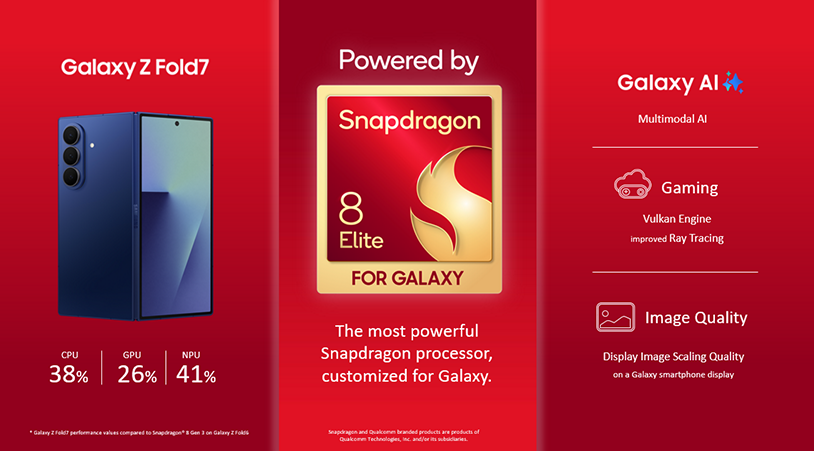
Samsung reports improvements of 40% in NPU performance, 37% in CPU performance and 30% in GPU performance compared with the previous generation of Galaxy S processors.
Samsung also developed additional thermal and display-related technologies around the processor.
The Galaxy S25 family therefore demonstrates an important point: manufacturers can customize the Snapdragon platform and combine it with their own hardware and software.
Xiaomi 15
The Xiaomi 15 is another major Snapdragon 8 Elite smartphone.
Xiaomi’s official specifications list:
- Snapdragon 8 Elite
- 2 Prime CPU cores up to 4.32GHz
- 6 Performance CPU cores up to 3.53GHz
- Adreno GPU
- 12GB RAM
- 256GB or 512GB storage
- LPDDR5X memory
- UFS 4.0 storage
The phone also features a 6.36-inch AMOLED display with a 1–120Hz refresh rate.
Gaming Phones With Snapdragon 8 Elite
Gaming-focused manufacturers have also adopted Snapdragon 8 Elite.
Devices such as ASUS ROG phones and RedMagic models combine the processor with aggressive cooling systems, high-refresh-rate displays and gaming-focused software.
These phones can be particularly interesting to gamers because the manufacturers design the complete device around sustained performance.
A gaming phone can devote more physical space to cooling than an ultra-thin conventional flagship.
That difference can become noticeable during long gaming sessions.
Snapdragon 8 Elite vs Previous Snapdragon Flagships
Compared with earlier Snapdragon flagship processors, Snapdragon 8 Elite represents a substantial architectural change.
The most important difference is the move to Qualcomm’s custom Oryon CPU architecture.
Qualcomm reports:
| Feature | Snapdragon 8 Elite |
|---|---|
| CPU architecture | Qualcomm Oryon |
| Maximum CPU speed | Up to 4.47GHz |
| Manufacturing process | 3nm |
| GPU | Qualcomm Adreno |
| AI processor | Qualcomm Hexagon NPU |
| 5G modem | Snapdragon X80 |
| Wi-Fi | Wi-Fi 7 |
| AI | Multimodal generative AI |
| Ray tracing | Supported |
| Gaming | Snapdragon Elite Gaming |
Qualcomm’s claimed improvements include 45% higher CPU performance, 40% higher GPU performance and major efficiency improvements over the preceding generation.
These are Qualcomm’s own comparative figures, so real-world results can vary by smartphone design and software.
Snapdragon 8 Elite vs Snapdragon 8 Elite Gen 5
This comparison is particularly important for shoppers in 2026.
The original Snapdragon 8 Elite launched in 2024.
Snapdragon 8 Elite Gen 5 arrived in 2025 as its successor and uses a third-generation Oryon CPU. Qualcomm lists up to 4.74GHz CPU speed on the standard version and claims 20% higher CPU performance, 23% higher GPU performance and 37% faster NPU performance compared with the original Snapdragon 8 Elite.
| Feature | Snapdragon 8 Elite | Snapdragon 8 Elite Gen 5 |
|---|---|---|
| Oryon generation | 2nd generation | 3rd generation |
| Launch | 2024 | 2025 |
| Process | 3nm | 3nm |
| Maximum CPU speed | Up to 4.47GHz | Up to 4.74GHz |
| CPU | Custom Oryon | Newer Oryon |
| GPU | Adreno | Newer Adreno |
| NPU | Hexagon | Newer Hexagon |
| 5G modem | X80 | X85 |
| Wi-Fi | Wi-Fi 7 | Wi-Fi 7 |
| Position | Original Elite flagship | Successor Elite flagship |
The original Snapdragon 8 Elite therefore remains a powerful flagship processor, but it should not be confused with the newer Gen 5 platform.
Is Snapdragon 8 Elite Still Powerful?
Yes, the specifications and architecture of Snapdragon 8 Elite remain firmly in flagship territory.
Its combination of a high-performance Oryon CPU, Adreno graphics, dedicated AI acceleration, advanced image processing and Wi-Fi 7 makes it suitable for demanding smartphone workloads.
For everyday tasks, its performance is more than sufficient for applications such as:
- Social media
- Web browsing
- Video streaming
- Photography
- Messaging
- Productivity
- Multitasking
The processor becomes particularly useful when handling demanding workloads such as:
- 3D gaming
- Video editing
- Generative AI
- Large photo libraries
- High-resolution recording
- Emulation
- Heavy multitasking
The bigger question in 2026 is not whether Snapdragon 8 Elite is capable, but how its price compares with phones using newer processors.
Snapdragon 8 Elite Pricing and Availability
Snapdragon 8 Elite itself is not normally purchased directly by consumers. It is integrated into smartphones, so pricing depends on the phone manufacturer, memory configuration, market and retailer.
Availability has been broad across Asia, Europe and the Americas, with Snapdragon 8 Elite smartphones sold through major manufacturers in these regions.
For example, OnePlus officially lists the OnePlus 13 in North America, while its Indian website lists multiple memory and storage configurations.
Xiaomi also markets Snapdragon 8 Elite-powered devices in European markets, including the Xiaomi 15.
Samsung’s Galaxy S25 series with Snapdragon 8 Elite for Galaxy was introduced globally.
Because individual smartphone prices change frequently, consumers should compare the current price of each model in their specific country rather than using the launch price of the processor generation as a reference.
Who Should Buy a Snapdragon 8 Elite Phone?
A Snapdragon 8 Elite phone makes the most sense for people who need high-end performance.
Mobile Gamers
The powerful Adreno GPU, ray-tracing capabilities and Snapdragon Elite Gaming technologies make the platform suitable for demanding games.
Content Creators
People who edit photos and videos directly on their phones can benefit from the combination of CPU, GPU, AI and ISP processing.
AI Users
Users who frequently use AI-powered photo editing, voice tools, translation and generative features can benefit from dedicated on-device AI acceleration.
Power Users
If you regularly multitask between demanding applications, Snapdragon 8 Elite provides substantial performance headroom.
Long-Term Buyers
High-end processors can provide enough performance headroom to remain capable as applications become more demanding.
However, processor performance should not be the only factor when buying a phone. Software update policies, camera quality, battery capacity, display quality, build quality and storage are equally important.
Who May Not Need Snapdragon 8 Elite?
Not every smartphone user needs a flagship processor.
If your main activities are messaging, social media, web browsing, email and video streaming, a modern mid-range processor can already provide a good experience.
Spending more for Snapdragon 8 Elite mainly makes sense when you need the additional performance or want a premium flagship experience.
This is especially relevant because flagship phones with Snapdragon 8 Elite can cost substantially more than mid-range Android smartphones.
Advantages of Snapdragon 8 Elite
The major strengths of the platform include:
Custom Oryon CPU
Qualcomm’s custom CPU architecture provides a major departure from earlier Snapdragon designs.
Strong GPU
The Adreno GPU provides the graphics power required for demanding modern mobile games.
Dedicated AI Hardware
The Hexagon NPU enables efficient AI processing directly on compatible devices.
Advanced Connectivity
The combination of X80 5G and FastConnect technologies provides modern cellular and wireless connectivity.
Improved Efficiency
Qualcomm’s claimed efficiency improvements can help manufacturers build powerful phones without proportionally increasing power consumption.
Advanced Camera Processing
The Spectra ISP and AI processing capabilities provide the hardware foundation for computational photography and sophisticated video features.
Limitations to Consider
Despite its impressive specifications, Snapdragon 8 Elite does not automatically guarantee that every phone using it will be excellent.
Thermal Performance Depends on the Phone
The same processor can behave differently in different devices because of cooling system design.
Battery Life Depends on More Than the SoC
Display technology, battery capacity and software optimization remain important.
AI Features Depend on Software
A phone may have the hardware needed for advanced AI but not offer every AI feature.
Peak Performance Is Not Everything
Benchmark scores can show the potential of a processor, but sustained performance, software optimization and real-world applications are often more important.
The Future of Snapdragon’s Elite Platform
The Snapdragon 8 Elite established a new direction for Qualcomm’s premium smartphone processors.
The move to Oryon created a foundation that Qualcomm subsequently continued developing.
The arrival of Snapdragon 8 Elite Gen 5 demonstrates that the Elite branding is now a continuing premium family rather than a one-off product name. The newer platform uses third-generation Oryon CPU technology and a newer X85 modem while increasing AI and graphics capabilities.
That means the original Snapdragon 8 Elite is likely to remain relevant in refurbished, discounted and previous-generation flagship smartphones even as newer Elite processors take over the most expensive devices.
For consumers, this could create an interesting market where last-generation Snapdragon 8 Elite phones become more affordable while still offering flagship-level performance.
Frequently Asked Questions About Snapdragon 8 Elite
Is Snapdragon 8 Elite the same as Snapdragon 8 Gen 4?
Yes. Snapdragon 8 Elite is the name Qualcomm used for the flagship processor that many people expected to be called Snapdragon 8 Gen 4. Qualcomm officially introduced it in October 2024.
Is Snapdragon 8 Elite a flagship processor?
Yes. It was Qualcomm’s flagship smartphone platform for its generation and introduced the company’s custom Oryon CPU architecture to smartphones.
How fast is Snapdragon 8 Elite?
Qualcomm lists a maximum CPU speed of up to 4.47GHz, although specific phones can use lower clock speeds. For example, OnePlus lists 4.32GHz for the OnePlus 13.
Does Snapdragon 8 Elite support ray tracing?
Yes. Snapdragon 8 Elite includes GPU technologies designed to support hardware-accelerated ray tracing and advanced mobile gaming graphics.
Is Snapdragon 8 Elite good for gaming?
Yes. Its high-performance Oryon CPU, Adreno GPU and Snapdragon Elite Gaming features make it suitable for demanding mobile games.
Does Snapdragon 8 Elite support AI?
Yes. The platform includes a Qualcomm Hexagon NPU designed for on-device AI and supports multimodal generative AI workloads.
Does Snapdragon 8 Elite support 5G?
Yes. The platform incorporates Qualcomm’s Snapdragon X80 5G Modem-RF System and supports advanced 5G technologies.
Does Snapdragon 8 Elite support Wi-Fi 7?
Yes. Snapdragon 8 Elite supports Wi-Fi 7 through Qualcomm FastConnect technology.
Which phones use Snapdragon 8 Elite?
Major examples include the OnePlus 13, Xiaomi 15, Xiaomi 15 Ultra, Samsung Galaxy S25 series, ASUS ROG Phone 9 series and RedMagic 10, among others. Qualcomm’s device finder provides a broader list.
Is Snapdragon 8 Elite better than Snapdragon 8 Gen 3?
Snapdragon 8 Elite is the newer flagship architecture and Qualcomm reports substantial CPU, GPU, AI and efficiency improvements compared with its predecessor generation. Actual performance varies by phone.
Is Snapdragon 8 Elite better than Snapdragon 8 Elite Gen 5?
The Snapdragon 8 Elite Gen 5 is the newer successor and provides newer CPU, GPU, AI and connectivity technologies. Qualcomm reports improvements over the original Snapdragon 8 Elite.
How long will Snapdragon 8 Elite remain relevant?
Its performance should remain sufficient for demanding smartphone applications for years, although newer processors will continue to offer higher performance and efficiency. Software support depends on the individual smartphone manufacturer.
Final Thoughts
The Snapdragon 8 Elite represented a major turning point for Qualcomm’s smartphone processor strategy by bringing its custom Oryon CPU architecture into the flagship mobile market. With a 3nm design, up to 4.47GHz CPU speed, powerful Adreno graphics, dedicated Hexagon AI acceleration, advanced camera processing, Wi-Fi 7 and the Snapdragon X80 5G modem, it created a powerful foundation for the 2025 generation of premium Android smartphones.
Qualcomm’s published figures indicate major improvements in CPU performance, GPU performance, AI processing and power efficiency compared with the previous generation. Smartphones such as the OnePlus 13, Xiaomi 15 and Samsung Galaxy S25 family demonstrate how different manufacturers can use the same platform to create very different flagship experiences. As newer processors such as Snapdragon 8 Elite Gen 5 become available, the original Snapdragon 8 Elite remains an important flagship platform and could become increasingly attractive as compatible smartphones move into lower price ranges across Asia, Europe and the Americas.
Sources: Qualcomm’s official Snapdragon 8 Elite specifications, Qualcomm’s Snapdragon 8 Elite announcement, OnePlus 13 official specifications and Xiaomi 15 official specifications.



[…] without moving to a large-screen smartphone. Announced in China in April 2025, the device combines Qualcomm’s Snapdragon 8 Elite processor, a 6.32-inch AMOLED display, a 6,260mAh battery, and a dual 50MP rear camera […]
[…] by Qualcomm’s Snapdragon 8 Elite mobile platform, the OnePlus 13 features a 6.82-inch QHD+ LTPO AMOLED display, a 6,000mAh silicon-carbon battery, […]