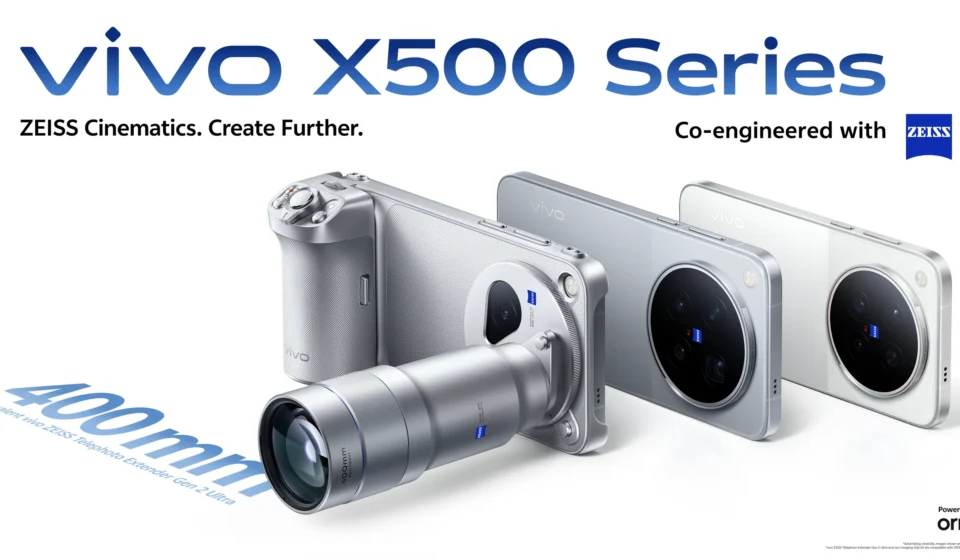
vivo X500 Series: X500, X500 Pro and X500 Pro Max Specifications, Features, Price and Availability

The vivo X500 series represents vivo’s latest flagship smartphone family, combining advanced mobile photography, powerful MediaTek processors, large-capacity batteries and premium displays. Unveiled in China on September 21, 2026, the lineup comprises three models: the vivo X500, vivo X500 Pro and vivo X500 Pro Max. The series is designed to serve different types of users, from everyday smartphone photographers to enthusiasts who want advanced zoom capabilities and professional-style video recording.
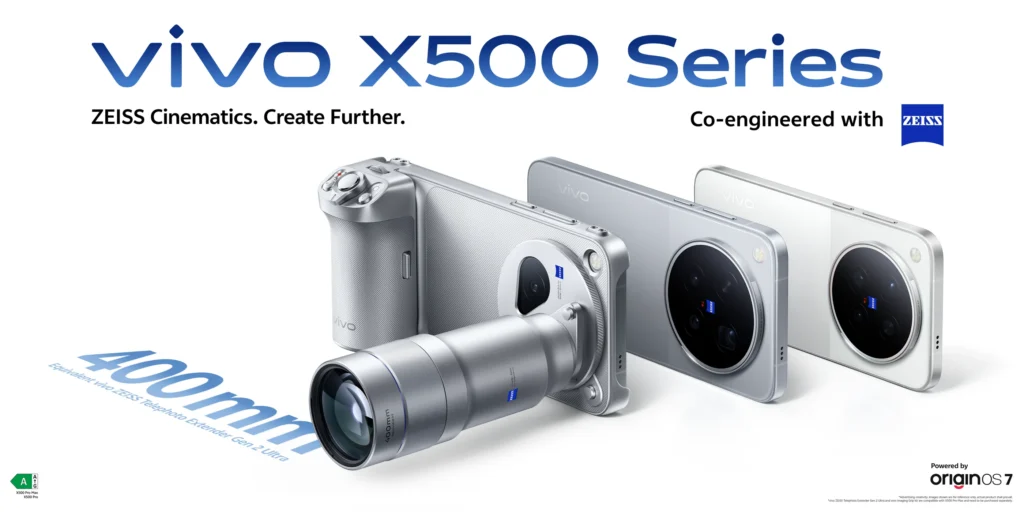
Photography is one of the central themes of the new lineup. Developed around vivo’s collaboration with ZEISS, the X500 family introduces advanced telephoto camera systems, specialised image-processing features and tools intended to help users capture portraits, distant subjects, sports, wildlife and other challenging scenes. The X500 Pro Max sits at the top of the range with a 200MP ZEISS APO telephoto camera and compatibility with a telephoto extender offering a reported 400mm-equivalent focal length.
Table of Contents
Performance is another important part of the package. The vivo X500 Pro and X500 Pro Max use the MediaTek Dimensity 9600 Pro, while the standard X500 uses the Dimensity 9600M. The phones also feature vivo’s OriginOS 7 software and BlueVolt battery technology, with capacities ranging from 6,510mAh to 7,800mAh across the three models.
The displays differ in size to accommodate different preferences. The X500 provides a 6.59-inch screen, the X500 Pro adopts a more compact 6.36-inch design, and the X500 Pro Max offers a larger 6.85-inch display with 2K resolution. All three models support 90W wired charging and 40W wireless charging, according to vivo’s published series information.
This article examines the design, specifications, cameras, performance, battery technology, software, pricing and regional availability of the vivo X500 series, with particular attention to China, other Asian markets, Europe and the United States.
vivo X500 Series Specifications at a Glance
| Feature | vivo X500 | vivo X500 Pro | vivo X500 Pro Max |
|---|---|---|---|
| Positioning | Standard flagship | Compact premium flagship | Top-tier imaging flagship |
| Processor | MediaTek Dimensity 9600M | MediaTek Dimensity 9600 Pro | MediaTek Dimensity 9600 Pro |
| Display size | 6.59 inches | 6.36 inches | 6.85 inches |
| Display resolution | 1.5K-class | 1.5K-class | 2K |
| Rear cameras | 50MP main, 50MP ultra-wide, 64MP telephoto | 50MP main, 50MP ultra-wide, 64MP telephoto | 50MP main, 50MP ultra-wide, 200MP telephoto |
| Telephoto system | 72mm-equivalent ZEISS APO telephoto | 85mm-equivalent ZEISS APO telephoto | 85mm-equivalent ZEISS APO telephoto |
| Front camera | 50MP | 50MP | 50MP |
| Battery | 7,500mAh | 6,510mAh | 7,800mAh |
| Wired charging | 90W | 90W | 90W |
| Wireless charging | 40W | 40W | 40W |
| Operating system | OriginOS 7 | OriginOS 7 | OriginOS 7 |
| Dust and water resistance | IP68/IP69 | IP68/IP69 | IP68/IP69 |
Specifications are based on vivo’s published series information. Individual configurations and features may vary by country and retail variant.
vivo X500 Series Design and Build Quality
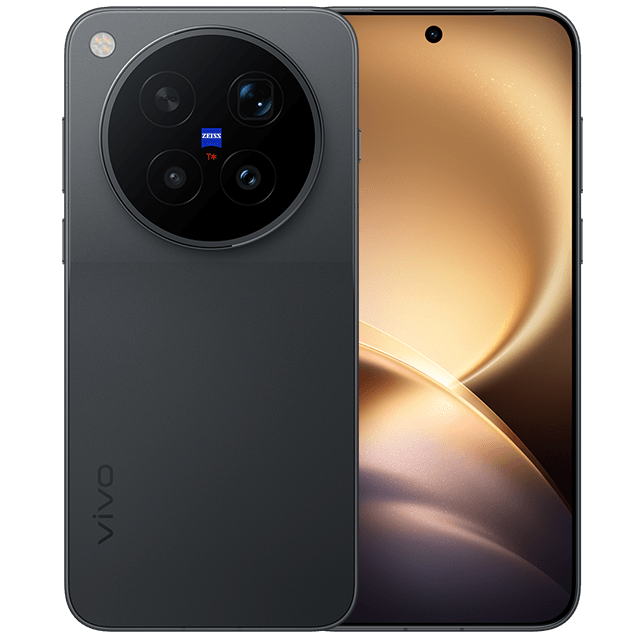
The vivo X500 family introduces different design approaches across the three models. The standard X500 features a redesigned floating camera module, while the Pro and Pro Max adopt vivo’s premium Tideline Design, in which the camera module transitions into the rear body through a smooth, flowing shape.
vivo X500: A Distinctive Floating Camera Module
The standard vivo X500 features a camera module positioned towards the upper-left portion of the rear panel. The design aims to give the phone a distinctive appearance while keeping it visually separate from the more premium-looking Pro models.
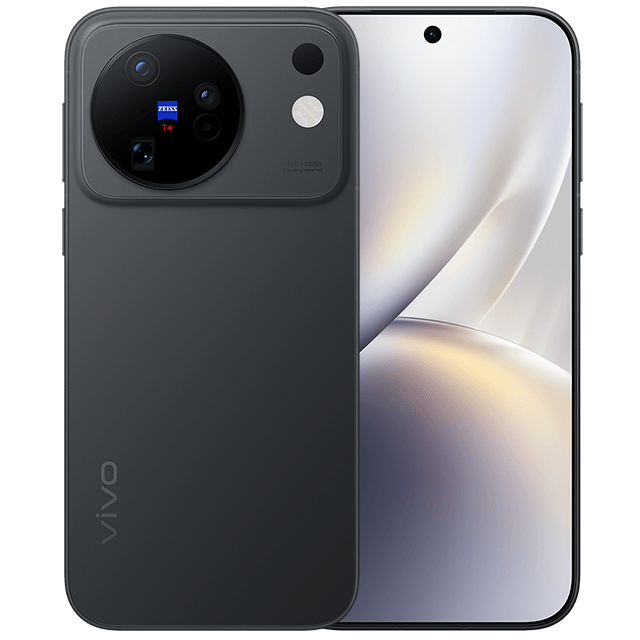
vivo lists the standard X500 in Dusk Black, Sunny White, Starry Gray and Dawn Pink. The availability of each finish may differ by market.
The standard model is intended to offer a balanced flagship experience without requiring buyers to select the largest or most expensive model in the family. Its 6.59-inch display sits between the compact X500 Pro and the larger Pro Max.
vivo X500 Pro and Pro Max: Tideline Design
The X500 Pro and X500 Pro Max use vivo’s Tideline Design, featuring a camera area that blends into the rear body with a smooth transition inspired by the shape of a receding tide. The centred circular camera module continues the visual identity associated with vivo’s premium camera-focused phones.
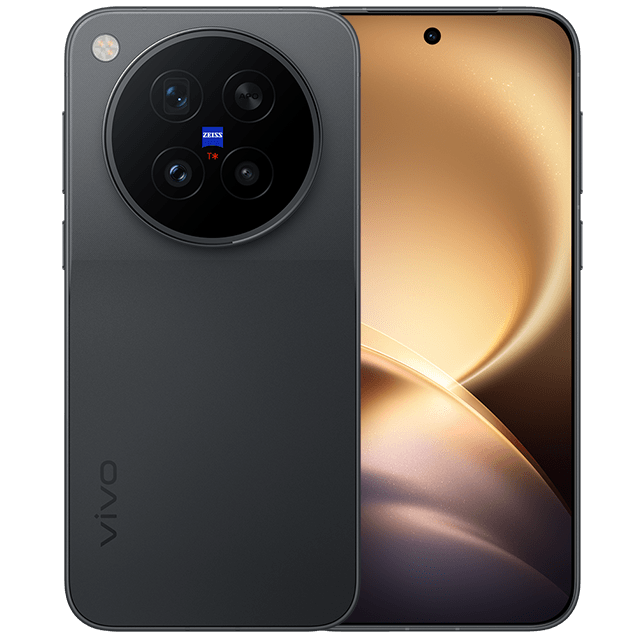
The Pro and Pro Max are listed in Moonlit Black, Sunny White, Starry Gray and Sunset Orange. Actual colour availability depends on the market and the specific configuration offered by local retailers.
Build Quality and Durability
All three models are listed with IP68 and IP69 dust and water resistance. These ratings indicate that the devices have been designed and tested for defined levels of protection against dust and water under specified laboratory conditions.
However, an IP rating does not mean a phone is indestructible or suitable for every underwater activity. Resistance can diminish through wear, impact damage or repairs. Liquid damage may also be excluded from warranty coverage, depending on the manufacturer’s terms.
The series also features 3D ultrasonic fingerprint scanning. This technology uses ultrasonic signals to read fingerprint characteristics and is designed to provide convenient biometric unlocking.
Display Technology: Three Sizes for Different Users
One of the defining differences between the vivo X500 models is their display size. Instead of making every phone equally large, vivo offers a smaller Pro model, a middle-sized standard model and a large-screen Pro Max.
vivo X500: 6.59-Inch Display
The standard X500 features a 6.59-inch display. This size provides room for reading, browsing, video playback, photography and gaming while remaining smaller than the Pro Max.
For people who want a flagship phone with a relatively generous screen but do not need the largest possible panel, the standard model may offer a practical compromise.
vivo X500 Pro: 6.36-Inch Compact Flagship
The vivo X500 Pro has a 6.36-inch display, making it the most compact model in the series. A smaller screen can make a phone easier to handle with one hand and more convenient to carry in a pocket.
Compact smartphones can appeal to users who prefer portability but still want premium processing power and advanced photography features. The X500 Pro aims to combine this smaller form factor with a capable camera system.
vivo X500 Pro Max: 6.85-Inch 2K Display
The Pro Max features a 6.85-inch 2K display. Its larger panel is designed for users who want a more immersive viewing experience when watching films, editing photos, reading documents or playing games.
The higher resolution can display fine details clearly, although its effect on battery consumption depends on the application, screen settings and software optimisation.
Colour Accuracy and Brightness
vivo says the series uses ZEISS Master Color Displays, with support for a wide P3 colour gamut and a reported global peak brightness of up to 2,000 nits. These features are intended to provide vivid yet controlled colour reproduction and improve visibility in bright environments.
Peak brightness is not necessarily the brightness a screen maintains across its entire surface or for an unlimited period. Actual outdoor visibility depends on ambient light, automatic brightness controls, reflections and the content being displayed.
Users who frequently edit photos or video may appreciate accurate colour reproduction, while people who mostly browse and stream content may value brightness, contrast and comfortable viewing modes.
Performance: MediaTek Dimensity 9600 Pro and Dimensity 9600M
The vivo X500 series uses different MediaTek processors according to model. The X500 Pro and Pro Max feature the Dimensity 9600 Pro, while the standard X500 uses the Dimensity 9600M.
Dimensity 9600 Pro in the Pro Models
The Dimensity 9600 Pro is designed to power the two higher-tier models. It provides the processing platform for demanding applications, advanced image processing and high-performance mobile gaming.
Flagship-class processors combine CPU cores for general computing with graphics hardware for games and visual workloads. They also incorporate specialised components for tasks such as image processing and artificial-intelligence acceleration.
In practical use, processor performance influences application responsiveness, game loading, multitasking and the speed of demanding creative tasks. However, real-world results also depend on memory capacity, software optimisation, cooling and application compatibility.
Dimensity 9600M in the Standard X500
The standard X500 uses the Dimensity 9600M. This allows vivo to differentiate the base model from the two Pro variants while retaining a modern processor designed for flagship-level everyday use.
Users who mainly browse the web, communicate, take photographs, stream videos and play common mobile games may find the standard model more than sufficient. More demanding users should compare independent performance tests before deciding whether the Pro models offer worthwhile advantages.
Gaming and Graphics Performance
The X500 series is equipped to handle demanding mobile games, although actual performance depends on the game and its supported settings. High-resolution displays and complex graphics can increase the workload placed on the processor.
Frame-rate stability, heat management, touch response and battery consumption are all important factors in the gaming experience. A processor’s peak benchmark score alone does not show how well a phone performs during an extended gaming session.
Independent reviews will help establish how the three models compare in sustained performance, temperature management and gaming endurance.
RAM and Storage
Memory and storage configurations vary by model and market. The Chinese lineup has been offered with different RAM and storage combinations, while international configurations may be more limited.
More RAM can help with multitasking, while larger storage capacities are useful for high-resolution video, large games and extensive photo libraries. Buyers should confirm the exact configuration rather than assume that every storage option will be available in every country.
Camera System: ZEISS Imaging Across the X500 Series
Photography is the central focus of the vivo X500 family. The series combines vivo’s image-processing technology with ZEISS-branded optical systems, including telephoto cameras designed for portraits, distant subjects and fast-moving scenes.
Although all three phones support advanced photography, their camera hardware differs, especially in the telephoto system. The Pro Max is the flagship option for users who prioritise long-range photography.
vivo X500: A Versatile Everyday Camera System
The standard vivo X500 combines a 50MP main camera, a 50MP ultra-wide camera and a 64MP telephoto camera, according to published specifications.
The main camera is intended for everyday photographs, including landscapes, family pictures, food, pets and street scenes. The ultra-wide camera is useful when the photographer needs to fit more of a scene into the frame.
The telephoto camera offers a different perspective for portraits and distant subjects. Its reported 72mm-equivalent focal length provides a moderately zoomed-in view that can be useful for framing people and objects without moving closer.
vivo X500 Pro: A Compact Phone with Advanced Telephoto Photography
The X500 Pro features a 50MP main camera, a 50MP ultra-wide camera and a 64MP ZEISS APO telephoto camera. The telephoto system uses an 85mm-equivalent focal length and a Sony LYTIA 610 sensor, according to vivo’s published information.
The APO designation refers to apochromatic optical design intended to help control colour fringing. ZEISS T* coating is also specified for the telephoto system, with the aim of improving optical performance by reducing certain reflections.
These optical features can be useful for portrait photography and subjects with strong contrast. Nevertheless, the final image depends on the lens, sensor, processing, lighting and shooting technique.
The X500 Pro supports a 200mm-equivalent ZEISS Telephoto Extender Gen 2 accessory. This optional accessory extends the phone’s telephoto capabilities for users who want to photograph subjects from farther away.
vivo X500 Pro Max: 200MP ZEISS APO Telephoto Camera
The vivo X500 Pro Max is the most photography-focused model in the lineup. Its main attraction is a 200MP ZEISS APO telephoto camera with an 85mm-equivalent focal length.
A high-resolution telephoto sensor can preserve fine details when photographing distant subjects, especially when combined with appropriate optics and image processing. It can be useful for concerts, sports, wildlife, travel and portrait photography.
The Pro Max also supports the vivo ZEISS Telephoto Extender Gen 2 Ultra, which provides a reported 400mm-equivalent focal length. The accessory is intended for long-range photography, where the subject may be too far away for a conventional smartphone telephoto camera.
The extender is an accessory rather than a replacement for the phone’s internal camera system. Its usefulness will depend on the shooting situation, available light, stabilisation and the photographer’s ability to keep the subject framed.
Long-Range Motion Snapshot
vivo has introduced Long-Range Motion Snapshot features on the Pro models. The company specifies support for 20x Long-Range Motion Snapshot on the X500 Pro and 30x on the X500 Pro Max.
These modes are designed to help capture moving subjects at greater distances. They may be particularly useful for sporting events, stage performances and other situations in which subjects move quickly or cannot be approached.
High magnification does not guarantee the same detail as native optical zoom. Results depend on the camera system, image processing, subject movement, lighting and stability.
Portrait Photography and Cinematic Portrait
The standard X500 introduces Cinematic Portrait features designed to adjust portrait lighting for different environments, including daylight, dusk and indoor scenes.
Portrait processing can help balance faces with their surroundings and create a more intentional visual style. However, natural-looking results depend on exposure, skin-tone rendering, background separation and the original lighting conditions.
Users who frequently photograph people may appreciate the combination of portrait processing and telephoto focal lengths across the series.
Video Recording and Content Creation
The X500 Pro and Pro Max are designed to support advanced video features, including 4K recording at 120 frames per second with autofocus tracking, according to vivo’s published series information.
High-frame-rate recording can capture more temporal detail and can be useful for action footage or slow-motion editing. Autofocus tracking helps maintain focus on a moving subject, which is important when filming sports, performances and moving people.
Autofocus Tracking and Auto Framing
Autofocus tracking is intended to keep a moving subject in focus as it moves through a scene. Auto Framing Video can help maintain a useful composition as the subject moves, reducing the need for constant manual camera adjustments.
These features can benefit creators recording events, short-form videos, travel content or informal interviews. Their performance will depend on lighting, subject movement and the camera mode selected.
4K Slow Motion and Professional Video Options
The X500 Pro and Pro Max have been associated with advanced high-frame-rate video capabilities, including 4K recording at 120fps. Some launch coverage also describes 4K 240fps slow-motion capability for the Pro Max, alongside 10-bit Log recording and cinematic video styles.
These modes can give experienced creators more flexibility when capturing action or adjusting the look of footage during editing. However, users should check the final camera menu and official regional specifications to establish which modes are available on each device.
High-resolution, high-frame-rate recording also requires storage space and processing power. Long recording sessions may consume substantial battery capacity and generate heat.
Battery Technology: BlueVolt and Large Capacities
Battery capacity is another major feature of the vivo X500 series. The lineup uses vivo’s BlueVolt battery system, with different capacities across the three models.
| Model | Battery Capacity | Wired Charging | Wireless Charging |
|---|---|---|---|
| vivo X500 | 7,500mAh | 90W | 40W |
| vivo X500 Pro | 6,510mAh | 90W | 40W |
| vivo X500 Pro Max | 7,800mAh | 90W | 40W |
Why Battery Capacity Matters
A larger battery provides more stored energy, which can be useful for gaming, navigation, photography, video recording and streaming. The X500 and Pro Max have particularly large stated capacities, while the compact Pro has a smaller battery to accommodate its more compact form factor.
Actual battery life depends on the display, brightness, mobile signal, processor workload, background applications and software optimisation. A phone with a larger battery may last longer, but capacity alone does not establish real-world endurance.
Semi-Solid-State Battery Technology
vivo describes the series as using second-generation semi-solid-state battery technology. The company says the battery system is designed to support reliable operation in temperatures as low as minus 20 degrees Celsius.
Battery performance can be affected by extreme temperatures. Cold conditions may temporarily reduce available battery performance, while excessive heat can accelerate battery degradation. The company’s stated temperature capability should be understood within the manufacturer’s test conditions and operating guidance.
90W Wired FlashCharge
All three phones support 90W wired FlashCharge. Fast charging is intended to reduce the time required to replenish the battery, particularly when the phone has been heavily used for gaming, video recording or navigation.
Peak charging power does not remain constant throughout the charging process. Charging speed depends on the battery’s state of charge, temperature, charger compatibility and power-management system.
40W Wireless Charging and Bypass Charging
The series also supports 40W wireless FlashCharge. Wireless charging provides convenience by allowing compatible phones to be placed on an appropriate charging accessory rather than connected directly by cable.
Bypass charging is another feature highlighted by vivo. When supported and enabled in suitable conditions, bypass charging can supply power to the phone’s system while reducing reliance on charging the battery directly. This can help manage heat during activities such as gaming while connected to a power source.
Users should follow the official instructions for compatible accessories and supported charging modes.
Software: OriginOS 7 and AI Features
The vivo X500 series runs OriginOS 7, vivo’s software platform based on Android. The interface combines the usual Android application ecosystem with vivo’s own system design, productivity features and AI-assisted tools.
Everyday Interface and Personalisation
OriginOS provides tools for managing the home screen, notifications, applications and system settings. The exact features available can vary according to the device model, software version, language and region.
For users moving from another Android phone, the transition should be familiar at a broad level, although the interface layout and preinstalled applications may differ from other manufacturers’ software.
Jovi AI Assistant
vivo highlights Jovi, its AI assistant, as part of the X500 series experience. The company describes a collection of productivity features designed to help users work with information on their devices.
Examples include tools that recognise information in screenshots, turn recognised schedules into reminders, and create transcripts or summaries from recordings. Availability can depend on language, region, supported applications and software version.
AI tools may save time when organising information, but users should review automatically generated reminders, transcripts and summaries for accuracy before relying on them.
Privacy and Software Updates
AI features and cloud-connected services can involve different privacy considerations depending on how the feature operates. Users should review the relevant settings and privacy notices to understand whether information is processed locally or sent to an online service.
vivo’s exact long-term operating-system and security-update commitment should be checked for the particular model and region. Software-support policies can vary across product families and markets.
Connectivity and Additional Features
The X500 series includes several hardware features intended to support daily convenience and connectivity. Published specifications highlight USB 3.2 and an infrared blaster across the lineup.
USB 3.2
USB 3.2 can provide higher data-transfer capability than older USB standards when the device, cable and connected equipment support compatible modes. This can be useful when transferring large video files or backing up photographs to a computer.
Actual transfer speed depends on the exact USB implementation, cable quality, connected device and file-transfer conditions.
Infrared Blaster
An infrared blaster can allow a compatible phone to control certain household electronics, such as televisions and air conditioners. The usefulness of this feature depends on the supported device database and the equipment in the user’s home.
Ultrasonic Fingerprint Scanner
The series includes 3D ultrasonic fingerprint scanning. This technology uses ultrasonic signals to read fingerprint details and provide biometric authentication.
Fingerprint unlocking offers a convenient alternative to entering a passcode repeatedly. Users should still maintain a strong screen lock and follow the security recommendations provided by the operating system.
Network Compatibility
Supported mobile bands and network features can differ between Chinese and international versions. Buyers importing a phone should verify its compatibility with their mobile operator before purchasing it.
This is particularly important for 5G connectivity, as a device may support 5G in one market without supporting all the frequency bands used in another.
vivo X500 vs X500 Pro vs X500 Pro Max: Which Model Is Best?
The three models target different user priorities. The best choice depends on whether a buyer values compactness, battery capacity, camera versatility or the most advanced zoom hardware.
Choose the vivo X500 for Everyday Flagship Use
The standard X500 is aimed at users who want a flagship smartphone with a large battery, a versatile camera system and a display that sits between the compact Pro and large Pro Max.
Its 7,500mAh battery and 6.59-inch screen could make it an attractive balance for everyday use. It also features a 64MP telephoto camera, which offers more flexibility than relying on the main camera alone.
Choose the vivo X500 Pro for a Compact Premium Phone
The X500 Pro is designed for people who prefer a smaller phone without abandoning premium processing and photography features. Its 6.36-inch display makes it the most compact model in the lineup.
It retains a 64MP ZEISS APO telephoto camera and uses the Dimensity 9600 Pro processor. Its 6,510mAh battery is smaller than those of the standard X500 and Pro Max, but the compact design may be more important to some buyers.
Choose the vivo X500 Pro Max for Long-Range Photography
The Pro Max is the top model for users who want the largest display and the most advanced telephoto system in the series. Its 200MP ZEISS APO telephoto camera and optional 400mm-equivalent extender make it especially interesting for long-range photography.
Its 7,800mAh battery and 6.85-inch 2K display also appeal to users who want a large-screen flagship. However, buyers should compare the final retail price and camera performance with competing flagship phones before deciding whether the Pro Max offers the right value.
vivo X500 Series Price in China
The X500 series was launched in China on September 21, 2026. Reports on the Chinese launch list the following starting prices for the base configurations.
| Model | Reported Starting Price in China | Approximate USD Equivalent |
|---|---|---|
| vivo X500 | CNY 5,499 | About US$770 |
| vivo X500 Pro | CNY 6,499 | About US$910 |
| vivo X500 Pro Max | CNY 6,999 | About US$980 |
These are reported Chinese launch prices for base configurations. USD figures are approximate conversions for comparison, not official US prices. Exchange rates, taxes and retail pricing may change.
vivo X500 Series Price and Availability in Asia
China is the original launch market for the X500 series. Availability in other Asian countries depends on vivo’s local launch plans, authorised retail channels and the configurations selected for each market.
India and other Asian markets may receive different storage options, colours, bundled accessories or model names. Buyers should consult their country’s official vivo website and authorised retailers for confirmed local pricing and warranty terms.
Imported Chinese models may be cheaper or more expensive than locally distributed devices depending on taxes, shipping, retailer margins and currency movements. They may also have different software configurations or cellular-band support.
vivo X500 Series Price and Availability in Europe
vivo has announced plans to introduce the X500 series in Europe. Reporting published in September 2026 indicated that the European launch event was scheduled for October 27, with sales expected to begin on November 5. Availability may differ by country.
Recent European price leaks have suggested the following prices, but these figures should not be treated as confirmed retail prices until vivo or authorised retailers publish them.
| Model | Reported European Price | Reported Configuration |
|---|---|---|
| vivo X500 Pro | €1,399 | 12GB RAM and 256GB storage |
| vivo X500 Pro Max | €1,799 | 12GB RAM and 512GB storage |
| vivo X500 Pro Max with camera kit | €1,999 | Reported bundle including camera accessories |
European prices above are based on media reports of leaked pricing, not confirmed final retail prices. The standard X500 may not be offered in every European market, and regional configurations can differ.
For European buyers, important considerations include the final price, local warranty, included charger, storage configuration and the availability of the telephoto extender. Buyers interested in the Pro Max camera kit should confirm exactly which accessories are included in the package.
vivo X500 Series Price and Availability in the United States
As of October 18, 2026, a confirmed official US retail launch and US pricing for the X500 series have not been established in the sources cited here.
Consumers considering importing one of the phones should verify carrier compatibility, supported 4G and 5G bands, software services, warranty coverage and access to repairs. A device designed for China or Europe may not support every network feature required by US carriers.
Import costs, sales taxes and retailer margins can also affect the final price. Until vivo confirms an official US release, any dollar price beyond a simple currency conversion should be treated as an estimate rather than an official retail price.
Advantages of the vivo X500 Series
- Three distinct models: Buyers can choose between a standard flagship, a compact Pro phone and a large-screen Pro Max.
- ZEISS camera systems: The lineup offers specialised optics and telephoto features for different photography needs.
- 200MP telephoto camera on Pro Max: The highest-tier model is designed for detailed long-range photography.
- Telephoto extender support: Compatible accessories extend the camera’s reach for selected shooting situations.
- Large batteries: Battery capacities range from 6,510mAh to 7,800mAh.
- Fast charging: All three models support 90W wired and 40W wireless charging.
- Flagship processors: The Pro models use the Dimensity 9600 Pro, while the standard model uses the Dimensity 9600M.
- Premium displays: The lineup includes screens up to 6.85 inches with 2K resolution on the Pro Max.
- Durability features: Published specifications list IP68/IP69 protection across the series.
Potential Disadvantages to Consider
- High purchase cost: The Pro models are positioned in the premium segment, and reported European prices are particularly high.
- Different battery capacities: The compact Pro has a smaller battery than the standard X500 and Pro Max.
- Accessory costs: The telephoto extender and camera kit may require additional spending.
- Regional differences: Colours, storage configurations, bundled accessories and availability can vary.
- Imported-phone limitations: Buyers may encounter network, warranty or software differences when importing a Chinese model.
- Camera performance requires testing: Sensor resolution alone does not establish real-world image quality.
Frequently Asked Questions About the vivo X500 Series
1. When was the vivo X500 series launched?
The vivo X500 series was unveiled in China on September 21, 2026. The lineup consists of the vivo X500, vivo X500 Pro and vivo X500 Pro Max.
2. What are the main differences between the three models?
The standard X500 has a 6.59-inch display and a 7,500mAh battery. The X500 Pro has a more compact 6.36-inch display and a 6,510mAh battery. The X500 Pro Max has a 6.85-inch 2K display, a 7,800mAh battery and a 200MP telephoto camera.
3. Which processor powers the vivo X500 series?
The X500 Pro and Pro Max use the MediaTek Dimensity 9600 Pro, while the standard X500 uses the Dimensity 9600M.
4. Does the vivo X500 Pro Max have a 200MP camera?
Yes. Its standout camera feature is a 200MP ZEISS APO telephoto camera. The phone also supports an optional telephoto extender with a reported 400mm-equivalent focal length.
5. What is the battery capacity of the vivo X500 series?
The standard X500 has a 7,500mAh battery, the X500 Pro has a 6,510mAh battery, and the X500 Pro Max has a 7,800mAh battery.
6. Does the vivo X500 series support wireless charging?
Yes. The published specifications list 40W wireless FlashCharge across the series, alongside 90W wired charging.
7. Which operating system does the vivo X500 series use?
The series runs OriginOS 7, vivo’s Android-based software platform. The availability of individual software and AI features can vary by region, language and model.
8. Is the vivo X500 series water-resistant?
Published specifications list IP68 and IP69 dust and water resistance for the three models. These ratings do not mean that the phones are indestructible or suitable for every underwater activity.
9. How much does the vivo X500 series cost?
Reported Chinese starting prices are CNY 5,499 for the X500, CNY 6,499 for the X500 Pro and CNY 6,999 for the X500 Pro Max. European prices have also been reported in leaks, but final regional prices should be confirmed with vivo or authorised retailers.
10. Will the vivo X500 series be available in the United States?
A confirmed official US retail launch has not been established in the sources cited here. Buyers should check vivo’s official regional announcements before importing a device.
11. Which vivo X500 model is best for photography?
The X500 Pro Max is the most specialised model for long-range photography because it has a 200MP ZEISS APO telephoto camera and supports a telephoto extender. The standard X500 and X500 Pro also provide versatile camera systems for everyday photography and portraits.
12. Is the telephoto extender included with the vivo X500 Pro Max?
The telephoto extender is an accessory. Buyers should check the exact package and regional offer to determine whether it is included or sold separately.
Conclusion
The vivo X500 series expands vivo’s flagship smartphone lineup with three models that target different user preferences. The standard X500 aims to balance everyday performance, photography and battery capacity. The X500 Pro offers a more compact design while retaining a premium processor and telephoto camera. The X500 Pro Max delivers the largest display and the most ambitious zoom system in the family.
The series’ major strengths include ZEISS-branded camera systems, large batteries, fast wired and wireless charging, and MediaTek’s latest flagship-class processors. The Pro Max is particularly noteworthy for its 200MP telephoto camera and compatibility with a long-range telephoto extender.
Nevertheless, the best model depends on individual needs and budget. The Pro Max is attractive for photography enthusiasts, while users who value a smaller phone may prefer the X500 Pro. The standard X500 may offer a more balanced option for those who want a large battery and versatile cameras without moving to the top model.
For buyers in Asia, Europe and the United States, regional pricing and availability are important considerations. Chinese launch prices provide a useful reference, but they should not be confused with official international prices. European price leaks should likewise be treated as provisional until final retail listings are confirmed.
Overall, the vivo X500 series is a significant addition to the premium Android smartphone market, particularly for users who prioritise mobile photography and battery capacity. Comparing local prices, camera performance, software support and warranty coverage will help buyers choose the model that best fits their needs.
Sources and References
- vivo: X500 Series announcement covering ZEISS telephoto cameras, battery capacities and key features
- PR Newswire: vivo X500 Series global announcement and product highlights
- Gadgets 360: Global launch timing, reported China prices and specifications
- GSMArena: vivo X500 Pro and Pro Max telephoto camera details
- My Mobile India: Reported European prices, storage options and colours
- The Verge: vivo X500 Pro Max camera technology, video features and launch details