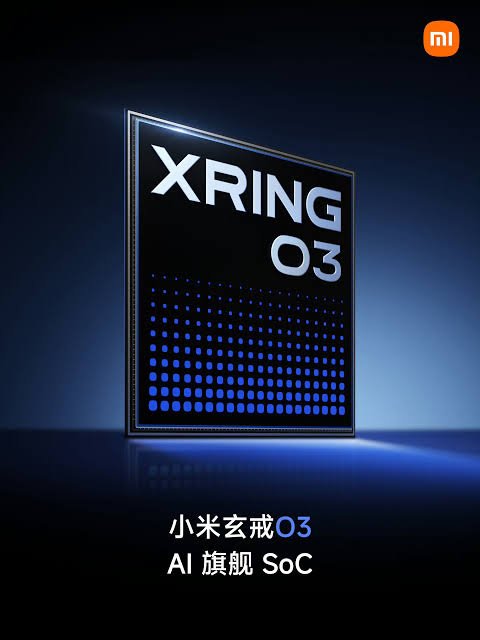

The Xiaomi XRING O3 is Xiaomi’s second-generation flagship mobile processor and one of the company’s most ambitious semiconductor projects to date. Announced in August 2026, the XRING O3 builds on the foundation established by the XRING O1 while introducing a substantially different CPU design, a new GPU architecture, faster memory support and a much more powerful AI processing system.
Unlike the XRING O1, which used a mixture of high-performance and efficiency-focused CPU cores, the XRING O3 adopts an all-big-core architecture. It combines 10 large CPU cores with a maximum clock speed of approximately 4.35GHz, a 16-core Arm G2-Ultra NX GPU, support for LPDDR6 memory and a dedicated AI engine that Xiaomi says can deliver up to 200 INT8 TOPS.
Table of Contents
The processor is manufactured using a TSMC 3nm process and contains approximately 24 billion transistors. Xiaomi claims the XRING O3 can achieve more than 5.2 million points in AnTuTu, while its CPU and GPU are substantially faster and more efficient than the previous XRING O1. Independent testing is now beginning to provide a clearer picture of what the chip can actually deliver in commercial devices.
What Is Xiaomi XRING O3?
The XRING O3 is Xiaomi’s flagship system-on-chip designed for premium smartphones and tablets.
It integrates the major computing components required by a modern mobile device into one semiconductor package, including:
- 10-core CPU
- Arm G2-Ultra NX GPU
- Dedicated NPU/AI processing hardware
- LPDDR6 memory controller
- Advanced cache system
- Image and multimedia processing
- Connectivity controllers
- Security and system-management components
Xiaomi officially introduced the XRING O3 in August 2026 as the successor to the XRING O1. The company skipped the XRING O2 designation and moved directly from O1 to O3.
The first major products to use the processor are the Xiaomi 18 Fold smartphone and Xiaomi Pad 9 Pro Max tablet. The 18 Fold is Xiaomi’s first flagship smartphone using XRING O3, while the Pad 9 Pro Max became the first Xiaomi tablet powered by the new processor.
Xiaomi XRING O3 Specifications
| Feature | Xiaomi XRING O3 |
|---|---|
| Manufacturer | Xiaomi |
| Processor type | Flagship mobile SoC |
| Manufacturing process | 3nm |
| Foundry | TSMC |
| Transistors | Approximately 24 billion |
| CPU | 10-core all-big-core design |
| Prime CPU cores | 2 × C1-Ultra |
| Prime clock | Up to 4.35GHz |
| Performance cores | 4 × C1-Premium |
| Performance clock | Up to about 3.68GHz |
| Large cores | 4 × C1-Pro |
| Large-core clock | Up to about 3.15GHz |
| GPU | Arm G2-Ultra NX |
| GPU cores | 16 |
| NPU | Dedicated AI processor |
| AI performance | Up to 200 INT8 TOPS |
| Memory | LPDDR6 |
| Memory bandwidth | Up to 113.8GB/s |
| Storage | UFS 4.1 |
| Wi-Fi | Wi-Fi 7 |
| Bluetooth | Bluetooth 6.0 |
| Maximum CPU clock | 4.35GHz |
| Initial devices | Xiaomi 18 Fold, Xiaomi Pad 9 Pro Max |
Specifications can vary slightly depending on the device implementation, especially memory configuration, thermal limits and performance modes.
3nm Manufacturing Process
The XRING O3 continues Xiaomi’s use of advanced 3nm semiconductor manufacturing.
The chip is reported to use TSMC’s N3P process, with a die area of approximately 133mm² and around 24 billion transistors. This makes it physically larger and considerably more transistor-dense than the 109mm² XRING O1.
The move to a more advanced 3nm implementation is important because Xiaomi is attempting to increase performance without proportionally increasing power consumption.
Modern flagship processors have to simultaneously handle:
- High-resolution displays
- AI applications
- Computational photography
- 4K and high-frame-rate video
- Advanced mobile gaming
- Multitasking
- 5G connectivity
- On-device generative AI
All of these workloads compete for a limited smartphone power and thermal budget.
A more advanced manufacturing process allows Xiaomi to increase transistor density while improving the potential balance between performance and efficiency.
A New 10-Core All-Big-Core CPU
One of the most interesting characteristics of XRING O3 is its CPU architecture.
Instead of using traditional efficiency cores, the processor uses 10 large CPU cores.
The configuration consists of:
- 2 × C1-Ultra
- 4 × C1-Premium
- 4 × C1-Pro
The two C1-Ultra cores can reach approximately 4.35GHz, while the four C1-Premium cores operate at up to around 3.68GHz and the four C1-Pro cores reach roughly 3.15GHz.
This is fundamentally different from the XRING O1.
The O1 used Cortex-X925, Cortex-A725 and Cortex-A520 cores. XRING O3 instead uses Xiaomi’s newer C1 family of large cores.
C1-Ultra Cores
The C1-Ultra cores sit at the top of the CPU hierarchy.
With a maximum clock speed of around 4.35GHz, they are designed for the most demanding workloads.
They can be used for:
- Heavy gaming
- Video editing
- Large AI calculations
- High-performance applications
- Complex multitasking
- Intensive web applications
C1-Premium Cores
Four C1-Premium cores provide the middle performance tier.
These cores can handle demanding applications without requiring every task to be pushed onto the two highest-clocked C1-Ultra cores.
C1-Pro Cores
The four C1-Pro cores operate at lower frequencies than the Ultra and Premium cores.
Although they are still considered large cores, their lower operating frequency allows them to handle moderate workloads more efficiently.
This three-tier approach allows Xiaomi’s scheduler to distribute workloads across different performance levels.
44MB of Combined Cache
XRING O3 also has a substantial cache system.
The processor reportedly contains:
- 12MB of L2 cache
- 16MB of L3 cache
- 16MB of system-level cache
That gives the chip approximately 44MB of on-chip cache when the different levels are combined.
Large cache capacity can reduce the number of times the CPU has to retrieve information from slower external memory.
This becomes especially important with an all-big-core design because multiple high-performance cores can generate significant amounts of data.
XRING O3 CPU Performance
Xiaomi positions XRING O3 as a substantial performance improvement over XRING O1.
The company has claimed around a 60% improvement in CPU performance over its previous generation in its internal comparisons.
Independent testing is now providing more useful context.
Notebookcheck’s XRING O3 database lists a Geekbench 6.7 single-core result of up to approximately 3,945 points from a development platform, while results from commercial devices can vary depending on thermal and software conditions.
An important distinction is that a development-board result should not automatically be treated as the performance users will experience in a retail smartphone.
Thermal limits, battery temperature, firmware, performance modes and sustained workloads can all influence benchmark results.
Nevertheless, the early results demonstrate that XRING O3 belongs firmly in the flagship performance category.
XRING O3 GPU
The graphics processor is one of the biggest changes compared with XRING O1.
XRING O3 introduces the Arm G2-Ultra NX GPU, featuring 16 GPU cores.
The GPU is particularly interesting because it combines conventional graphics processing with dedicated neural-network acceleration. Eight of the GPU compute units reportedly incorporate NX tensor accelerators designed to accelerate AI-assisted graphics workloads.
This architecture allows AI processing to take place closer to the graphics pipeline.
That can be useful for:
- Super-resolution
- Frame generation
- Ray-tracing enhancement
- AI denoising
- Image reconstruction
- Gaming upscaling

GPU Performance
Xiaomi claims that the G2-Ultra NX delivers up to 85% higher graphics performance than the XRING O1 while using up to 64% less power at comparable peak performance. Xiaomi has also claimed a major improvement in ray-tracing performance.
Independent testing provides some support for the scale of the improvement.
Notebookcheck reports a Steel Nomad Lite score of approximately 4,567, representing an 85% increase over the O1 in that particular test. Its Solar Bay Extreme result was around 3,628, with Xiaomi reporting a 182% improvement over its previous chip in that workload.
These figures should still be interpreted as benchmark results rather than guarantees of gaming performance in every application.
AI-Powered Graphics
One of the most important features of XRING O3 is that AI is integrated directly into the GPU architecture.
Traditional mobile graphics pipelines render an image and then rely on additional processing stages to improve it.
The G2-Ultra NX can instead use neural accelerators integrated within the GPU for techniques such as AI upscaling.
This can enable a game to render internally at a lower resolution and then use AI processing to reconstruct a higher-resolution image.
The result can potentially be:
- Higher frame rates
- Sharper images
- Lower rendering workloads
- Reduced memory traffic
- Better power efficiency
Arm has described the G2-Ultra NX architecture as supporting technologies such as neural super sampling, frame generation and neural denoising.
This brings mobile gaming closer to the AI-assisted rendering techniques increasingly used on PCs.
Ray Tracing Performance
Ray tracing is another area where XRING O3 represents a major step forward.
The GPU’s architecture is designed to accelerate modern graphics effects while using AI techniques to improve image quality.
Xiaomi has reported a 182% improvement in ray-tracing performance over XRING O1 in its testing. Notebookcheck independently recorded a Solar Bay Extreme result that Xiaomi says represents a 182% improvement over the O1.
Ray tracing is computationally expensive, so improving both raw graphics performance and AI-assisted reconstruction can make the technology more practical on mobile devices.
200 TOPS AI Performance
AI processing is perhaps the most dramatic improvement in XRING O3.
The processor’s dedicated AI hardware is reported to provide up to 200 INT8 TOPS.
That is a significant increase over the XRING O1’s 44 TOPS NPU rating.
Xiaomi has designed the AI system around increasingly demanding on-device workloads.
Potential applications include:
- Generative AI
- Image generation
- Voice recognition
- AI assistants
- Real-time translation
- Photo enhancement
- Video enhancement
- Document processing
- AI search
- Gaming graphics
- Large language models
Xiaomi has also redesigned its NPU architecture for its MiMo on-device AI platform.
The company says the new AI hardware can deliver a 45% improvement in edge AI performance compared with the previous generation.
AI Is No Longer Limited to the NPU
Another important aspect of XRING O3 is that AI acceleration is distributed throughout the processor.
The CPU reportedly includes two SME2 acceleration units, while the GPU incorporates eight NX neural-network accelerators.
This means AI workloads do not necessarily have to be processed exclusively by the NPU.
Different types of AI calculations can be assigned to the most appropriate hardware.
For example, a graphics-related AI operation can be handled directly by the GPU’s neural accelerators, while another machine-learning task can be sent to the dedicated NPU.
This approach can reduce unnecessary movement of data between different processing units.
LPDDR6 Memory Support
One of the biggest technological changes introduced by XRING O3 is LPDDR6 memory support.
The chip reportedly uses a 96-bit memory controller and supports LPDDR6-10667, providing memory bandwidth of approximately 113.8GB/s.
Xiaomi says this represents approximately a 48% increase in memory bandwidth compared with XRING O1.
Higher memory bandwidth is especially valuable for:
- AI models
- High-resolution graphics
- Large games
- Video editing
- Multitasking
- Image processing
The additional bandwidth can help prevent the CPU and GPU from waiting for data.
Why LPDDR6 Matters
LPDDR6 is particularly important because mobile processors are increasingly becoming data-hungry.
AI models can require enormous amounts of memory bandwidth.
High-resolution games also continuously move textures and graphics data between memory and the GPU.
Similarly, advanced camera systems can generate large quantities of image data that must be processed in real time.
By adopting LPDDR6, Xiaomi is preparing XRING O3 for these workloads.
The Xiaomi 18 Fold is among the first commercial devices associated with the technology, while reports have also identified next-generation LPDDR6 supplied by Chinese memory manufacturer CXMT.
Storage Support
XRING O3-class devices can also pair the processor with high-speed storage.
The platform supports UFS 4.1, allowing compatible devices to take advantage of fast storage performance.
This matters when dealing with:
- Large games
- 4K and 8K video
- AI models
- Large applications
- High-resolution photographs
- Rapid file transfers
Fast storage combined with fast LPDDR6 memory gives the processor a high-bandwidth platform for demanding workloads.
Connectivity
XRING O3 also supports modern connectivity technologies expected from a flagship mobile platform.
These include:
- Wi-Fi 7
- Bluetooth 6.0
- USB connectivity
- Modern cellular connectivity through the complete device platform
The exact modem configuration can vary according to the final device because an SoC’s application processor capabilities and the complete smartphone radio system are not necessarily identical.
XRING O3 Gaming Performance
Gaming is one of the areas where XRING O3 could have a significant impact.
The combination of:
- 10 high-performance CPU cores
- 16-core G2-Ultra NX GPU
- AI graphics accelerators
- Improved ray tracing
- High memory bandwidth
- LPDDR6
- AI super-resolution
creates a platform specifically suited to high-end mobile gaming.
Rather than simply increasing raw GPU power, Xiaomi is attempting to improve performance through AI-assisted rendering.
A game could potentially render fewer pixels natively and use neural super-resolution to reconstruct the final image.
That can reduce GPU workload while maintaining visual quality.
XRING O3 and AI Frame Generation
AI frame generation is another technology enabled by the new GPU architecture.
Instead of rendering every frame entirely through conventional graphics calculations, AI algorithms can analyze consecutive frames and generate additional intermediate frames.
When implemented properly, this can increase perceived frame rates.
The challenge is latency.
A frame-generation system must create additional frames without introducing noticeable control delay.
The G2-Ultra NX’s integration of neural accelerators directly into the graphics pipeline is intended to reduce the overhead involved in these operations.
XRING O3 vs XRING O1
The difference between XRING O1 and XRING O3 is substantial.
| Feature | XRING O1 | XRING O3 |
|---|---|---|
| Process | 3nm | 3nm |
| CPU cores | 10 | 10 |
| CPU design | Cortex-X925/A725/A520 | C1-Ultra/Premium/Pro |
| CPU architecture | Mixed core types | All-big-core |
| Maximum clock | Up to 3.9GHz | Up to 4.35GHz |
| GPU | Immortalis-G925 | G2-Ultra NX |
| GPU cores | 16 | 16 |
| AI | 44 TOPS | Up to 200 INT8 TOPS |
| Memory | LPDDR5T | LPDDR6 |
| Bandwidth | Lower | Up to 113.8GB/s |
| Transistors | 19 billion | About 24 billion |
| Die size | About 109mm² | About 133mm² |
The O3 therefore represents more than a clock-speed upgrade.
Xiaomi has redesigned the CPU architecture, introduced a new GPU, significantly expanded AI processing and adopted the next generation of mobile memory.
The result is a much more ambitious flagship platform.
XRING O3 vs Snapdragon
XRING O3 enters a highly competitive flagship processor market dominated by Qualcomm and MediaTek.
Qualcomm’s Snapdragon flagship platforms have traditionally been strong in CPU performance, GPU performance, modem technology and developer support.
Xiaomi’s strategy with XRING O3 is different.
Instead of competing purely through CPU clock speeds, Xiaomi has emphasized:
- All-big-core CPU architecture
- High memory bandwidth
- Integrated AI acceleration
- AI-assisted graphics
- Advanced ray tracing
- Power efficiency
Xiaomi has claimed that XRING O3 can compete with leading flagship platforms while consuming substantially less power in certain workloads.
These claims should be interpreted as Xiaomi’s own test results rather than universal performance measurements. Independent tests are more useful for comparing retail devices under equivalent conditions.
XRING O3 vs Apple Silicon
Xiaomi has also made comparisons with Apple’s high-performance chips.
The company has claimed that XRING O3’s CPU multi-core and GPU performance approaches Apple’s M5 platform in some of its internal comparisons, particularly considering the difference between a mobile SoC and a larger desktop-class chip.
Such comparisons should be treated carefully.
Apple’s M-series processors are used across laptops and tablets and can operate under significantly different thermal and power conditions.
A smartphone processor cannot necessarily sustain the same performance as a laptop chip simply because a benchmark score appears comparable.
Nevertheless, Xiaomi’s comparison illustrates the company’s ambitions for XRING O3.
XRING O3 AnTuTu Score
One of the most widely reported figures associated with XRING O3 is its AnTuTu score.
Xiaomi has claimed an AnTuTu score of approximately 5.22 million points, making it one of the first mobile processors publicly associated with a score above five million.
The Xiaomi Pad 9 Pro Max was subsequently reported with a Xiaomi-claimed AnTuTu score of approximately 5.61 million points.
However, benchmark numbers should not be treated as direct measurements of processor performance alone.
AnTuTu evaluates multiple areas, including CPU, GPU, memory and user-experience performance.
The final score can therefore be affected by:
- RAM type
- Storage
- Cooling
- Firmware
- Performance mode
- Device temperature
- Display resolution
- Battery state
For this reason, the 5-million-plus score is best viewed as an indicator of the platform’s overall flagship performance rather than a universal speed rating.
XRING O3 Devices
Xiaomi 18 Fold
The Xiaomi 18 Fold is the first Xiaomi flagship smartphone powered by XRING O3.
The wide foldable was officially showcased at IFA 2026 before its Chinese launch. Xiaomi confirmed that it would use the new processor and LPDDR6 memory.
The device is particularly significant because it demonstrates that Xiaomi is willing to put its newest proprietary processor into a high-profile flagship smartphone rather than limiting it to a lower-risk product.
Xiaomi Pad 9 Pro Max
The Xiaomi Pad 9 Pro Max is the first Xiaomi tablet to use XRING O3.
It features a 13.3-inch 3.4K 144Hz display and configurations reaching 16GB of RAM and 1TB of storage.
The tablet also uses a 12,000mAh battery with 120W charging.
The larger chassis provides Xiaomi with more thermal headroom than a smartphone, making the tablet an important platform for demonstrating sustained XRING O3 performance.
XRING O3 in Xiaomi Pad 9 Pro Max
The Pad 9 Pro Max provides an interesting example of what the processor can achieve in a large device.
Xiaomi claims:
- 5.61 million AnTuTu points
- 54% higher CPU multi-core performance than XRING O1
- 85% higher GPU performance
- Up to 64% lower power consumption
- Up to 4.35GHz CPU frequency
The tablet also supports advanced AI rendering, including high-resolution frame interpolation and super-resolution technologies in supported games.
Power Efficiency
Performance alone does not determine whether a mobile processor is successful.
The XRING O3’s all-big-core architecture makes efficiency particularly important because ten large cores could potentially consume considerable power under sustained workloads.
Xiaomi therefore emphasizes power efficiency alongside performance.
The company claims that the GPU can deliver O1-level peak performance while consuming up to 64% less power, while other reports cite significant efficiency gains in medium and low workloads.
Real-world battery life depends on the device, however.
A tablet with a 12,000mAh battery and large cooling system will behave very differently from a thin foldable smartphone.
Thermal Management
The XRING O3’s thermal behavior is an important subject for independent testing.
Its CPU contains ten large cores, with two capable of reaching 4.35GHz.
That design can produce substantial performance, but sustained performance depends on the device’s ability to dissipate heat.
A phone may achieve very high peak benchmark numbers and then reduce clock speeds during a prolonged workload.
The Xiaomi Pad 9 Pro Max has more physical space for thermal management, while the Xiaomi 18 Fold has to balance performance against the constraints of a thin folding design.
This means future long-duration gaming and stress testing will be particularly useful for evaluating the processor.
Why XRING O3 Is Important for Xiaomi
The importance of XRING O3 extends beyond raw performance.
Xiaomi is gradually building its own semiconductor ecosystem.
The company now has experience developing:
- Smartphone application processors
- Wearable processors
- AI-focused chips
- Automotive processors
- Image-processing technology
XRING O3 shows that Xiaomi intends to compete at the highest end of mobile semiconductor design.
This can provide greater control over the relationship between:
Processor + AI + Camera + HyperOS + Memory + Device Hardware
That integration could eventually allow Xiaomi to optimize its products in ways that are difficult when relying entirely on third-party SoCs.
The Importance of Skipping XRING O2
One interesting detail is Xiaomi’s move from XRING O1 directly to XRING O3.
The company has not publicly positioned an XRING O2 as the commercial successor between the two chips.
Instead, the O3 represents a major architectural jump.
The change in naming is less important than what the processor actually delivers, but moving directly to O3 gives the new platform a clear generational identity following Xiaomi’s first flagship XRING processor.
Future of Xiaomi XRING Processors
XRING O3 could be the beginning of a much larger Xiaomi semiconductor strategy.
The company has already expanded its in-house chip efforts beyond application processors.
In 2026, Xiaomi introduced the XRING O3 alongside other internally developed chips, including the AI-focused XRING O100 and automotive-oriented XRING D100.
This suggests Xiaomi’s semiconductor ambitions extend beyond smartphones.
Future XRING processors could potentially appear in:
- Smartphones
- Tablets
- Foldables
- AI devices
- Smart-home products
- Vehicles
- Connected hardware
The more Xiaomi develops its own silicon, the more closely it can integrate processing with its wider ecosystem.
Frequently Asked Questions About Xiaomi XRING O3
What is Xiaomi XRING O3?
XRING O3 is Xiaomi’s latest flagship in-house mobile processor. It uses a 3nm manufacturing process, a 10-core all-big-core CPU, a 16-core G2-Ultra NX GPU and advanced AI processing hardware.
How many cores does XRING O3 have?
XRING O3 has 10 CPU cores: two C1-Ultra cores, four C1-Premium cores and four C1-Pro cores.
What is the maximum XRING O3 clock speed?
The two C1-Ultra CPU cores can reach approximately 4.35GHz.
What GPU does XRING O3 use?
The processor uses a 16-core Arm G2-Ultra NX GPU with integrated neural-network acceleration.
How powerful is the XRING O3 NPU?
Xiaomi’s reported specifications put the dedicated AI processor at up to 200 INT8 TOPS.
Does XRING O3 support LPDDR6?
Yes. XRING O3 supports LPDDR6 memory with reported bandwidth of up to approximately 113.8GB/s.
Is XRING O3 faster than XRING O1?
Yes, based on Xiaomi’s own performance comparisons and early independent testing, XRING O3 represents a substantial performance improvement over XRING O1. Xiaomi claims approximately 60% higher CPU performance and up to 85% higher GPU performance in its comparisons.
What phones use XRING O3?
The Xiaomi 18 Fold is the first flagship smartphone announced with XRING O3.
What tablet uses XRING O3?
The Xiaomi Pad 9 Pro Max is the first Xiaomi tablet powered by XRING O3.
Is XRING O3 made on 3nm?
Yes. Reports identify the processor as being manufactured using TSMC’s N3P 3nm process.
Does XRING O3 support ray tracing?
Yes. Its G2-Ultra NX graphics architecture is designed for advanced graphics and ray-tracing workloads, while Xiaomi reports a substantial ray-tracing improvement over XRING O1.
Final Thoughts on Xiaomi XRING O3
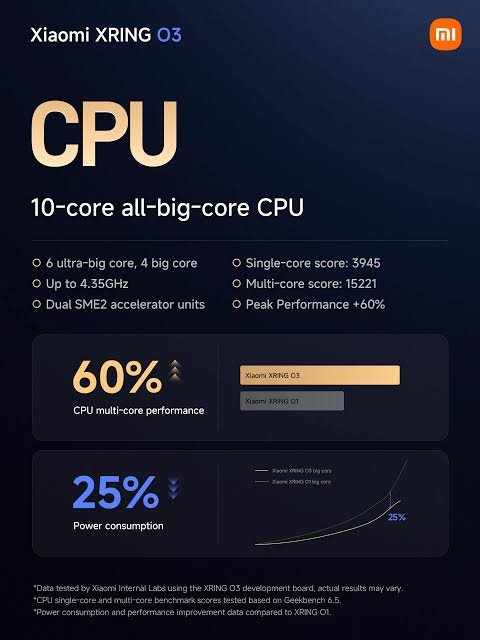
The Xiaomi XRING O3 represents a major evolution of Xiaomi’s in-house processor strategy. Compared with the XRING O1, it introduces a completely new all-big-core CPU architecture, a 16-core G2-Ultra NX GPU, LPDDR6 memory support, significantly expanded AI acceleration and a much larger transistor budget. Xiaomi claims up to 60% higher CPU performance, 85% higher GPU performance and 64% lower GPU power consumption compared with the previous generation, while independent early testing confirms that the processor is firmly in flagship territory.
The most interesting part of XRING O3, however, is its emphasis on AI-powered computing. Instead of treating AI as a separate NPU function, Xiaomi has integrated neural acceleration into the CPU and GPU as well. This makes features such as neural super-resolution, frame generation and advanced on-device AI possible without relying entirely on cloud processing. Its support for LPDDR6 also gives the processor substantially more memory bandwidth for demanding AI and graphics workloads.
XRING O3 therefore represents more than an incremental upgrade to Xiaomi’s first-generation silicon. It is evidence that Xiaomi is attempting to build a broader semiconductor platform capable of supporting smartphones, foldables, tablets, AI products and potentially other connected devices. The Xiaomi 18 Fold and Xiaomi Pad 9 Pro Max provide the first commercial demonstrations of this technology, while future XRING generations will determine how far Xiaomi’s in-house silicon strategy can develop.
Sources: Xiaomi’s published XRING materials and corporate announcements, Notebookcheck



[…] recent history. Introduced in May 2025, it marked Xiaomi’s return to designing its own smartphone-class flagship silicon after years of relying primarily on chipmakers such as Qualcomm and […]
[…] productivity computer. Announced in China in September 2026, it combines a 13.3-inch 3.4K display, Xiaomi’s new XRing O3 processor, up to 16GB of RAM, up to 1TB of storage, a 12,000mAh battery and 120W fast […]